Walk through a handful of listing sheets for oceanfront cottages along Puako Beach Drive and you'll hit the same two lines more often than not: Water, Catchment. Sewer, Cesspool. On paper, that's a red flag that should scare off any careful buyer, and in most Hawaii Island coastal neighborhoods, it should give you real pause about cost and timeline. In Puako, the calculation is more specific than that, and most generic guides to buying Hawaii property won't tell you why.
Hawaii's Act 125, passed in 2017, requires every cesspool in the state to be upgraded, converted to septic, or connected to sewer by January 1, 2050. Hawaii Island carries the heaviest share of that burden by far. A county task force report released in December 2025 put the number at roughly 49,000 of the state's 83,000 cesspools sitting on this island, releasing an estimated 52 to 55 million gallons of raw sewage into the ground every day. Puako has been named specifically in this conversation for years, not because its problem is unique, but because its coastline sits close enough to the reef that the effluent shows up fast. Nitrogen runoff from cesspools has been documented damaging coral near Paniau Beach.
What makes Puako different from a similarly situated cesspool property in, say, Miloli'i or Kahalu'u isn't the underlying environmental problem. It's that Puako residents didn't wait for the county to get around to them.
The community built the plan the county couldn't
A volunteer nonprofit called Puako For Reefs has spent more than a decade pushing a specific technical solution: a low-pressure, liquid-only sewer system designed for the neighborhood's lava-rock substrate. Traditional gravity sewers need pipes up to 60 inches wide buried deep enough to work by gravity alone, which is expensive and often impractical to dig through rock. The Puako design grinds waste at each property, lets the liquid rise to the top, and moves it through a 6-inch pipe that can sit much closer to the surface. The remaining solids stay in a small tank that gets pumped out every five to eight years, the same way a conventional septic tank works today. The treated effluent would meet the state's recycled-water standard for approved irrigation reuse, potentially including the fuel break that already runs along the community's main road as a fire-access lane.
The organizers, including Puako For Reefs volunteers Barbara Bell and Roy Takemoto, have testified in front of Hawaii County's Environmental Management Commission and hired an engineering firm to turn the concept into an actual basis of design. At an August 2025 commission meeting, county planners said the island's integrated wastewater management plan was still in draft, with a final version targeted for early 2026. What has shifted since then is county buy-in on the Puako project specifically. Hawaii Island Mayor Kimo Alameda, who was reportedly skeptical of a Puako-specific sewer project as recently as fall 2025, told Honolulu Civil Beat this year that the community's organizing had earned his support.
"This is the most organized community right now. They have a plan. This could be the model for the state. After Puakō, it could be Kahalu'u. After Kahalu'u it could be Miloli'i. After Miloli'i, it could be Keaukaha or any of those kinds of Priority One coastal areas."
That quote matters to anyone underwriting a purchase here, because it tells you Puako is likely to get a functioning wastewater solution years before other comparable coastal communities on this island, simply because the residents did the organizing work the county wasn't positioned to do on its own. The feasibility study explicitly noted that individual homeowners can't fund a project like this alone, which is why ownership was being modeled as either a county utility or a homeowners' association structure rather than a per-lot obligation. Neither of those structures had been finalized as of the most recent public reporting.
The setback problem sitting on top of the sewer problem
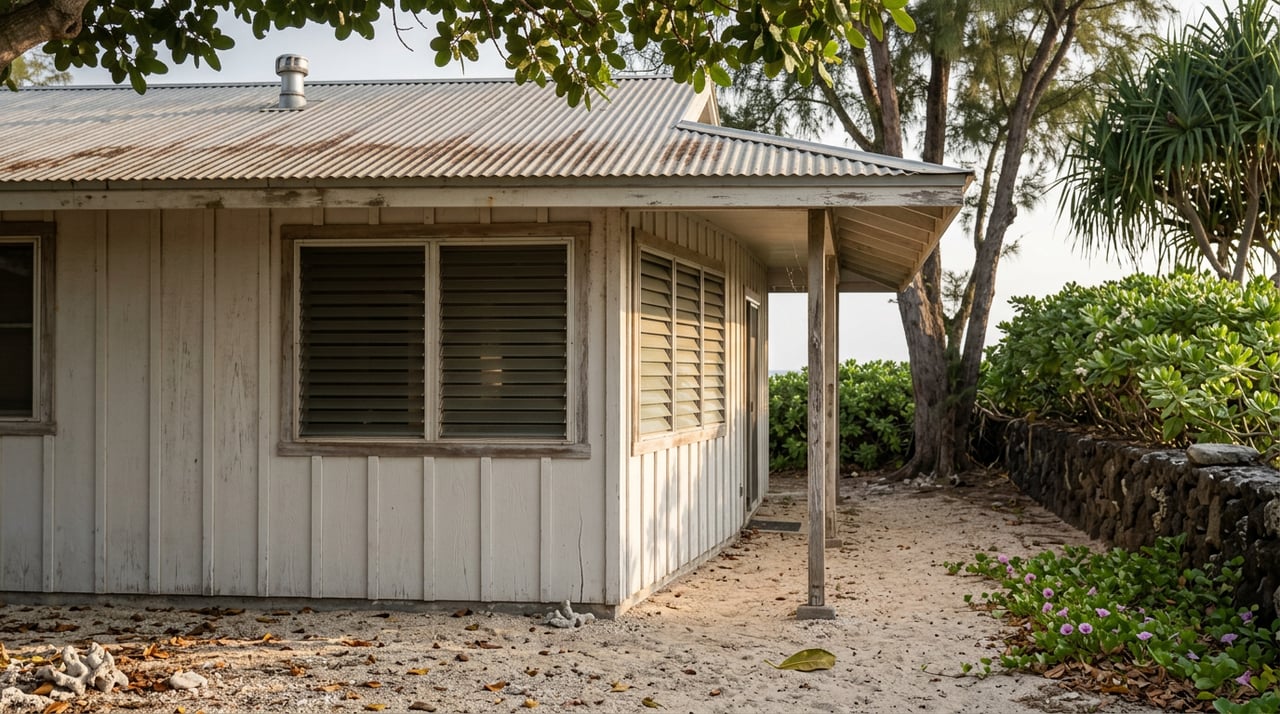
Here's where the picture gets more complicated for a specific kind of Puako property: the small, original-era oceanfront cottage.
Hawaii County's shoreline setback rule, administered under Planning Department Rule 11, currently requires a minimum 40-foot setback from the certified shoreline for any lot abutting the coast. That's a relatively recent change. The county's setback had been 20 feet until an amendment tied to a 2020 state law pushed it to 40 feet, following the same pattern the neighbor islands adopted around the same time. A lot of Puako's original beach cottages were built decades before that rule existed, which means some of them now sit closer to the water than a new structure would be allowed to. That status, sometimes called legal nonconforming, doesn't force anyone to move or tear down an existing home. It does mean that a substantial renovation or rebuild has to meet today's setback, not the rule that was in place when the cottage went up. A cottage sitting closer to the water than current rules would permit for new construction can usually stay exactly as it is, but expanding it, or rebuilding after significant damage, typically means applying for a shoreline setback variance rather than simply pulling a standard permit.
Put the two issues together and you get the real due-diligence question for an older Puako cesspool cottage: not just "what will it cost to fix the wastewater," but "how much of this lot can even be rebuilt if I need to." A buyer evaluating a fixer-upper on the ocean side should ask both questions before assuming the eventual value of the improved property.
What the price bands actually tell you
Puako's pricing spread is wide enough that a single median doesn't say much on its own. Homes on the mauka side of Puako Beach Drive, away from direct oceanfront, typically run from the $800,000s up to roughly $1.5 million depending on finish level. On the ocean side, the range opens up dramatically: entry-level oceanfront opportunities, generally the older, unrenovated cottages, start as low as $2.5 million, while larger or fully rebuilt oceanfront estates commonly run $8 million to $10 million, with occasional outlier listings well above that.
| Puako segment | Typical 2026 price range | What you're likely buying |
|---|---|---|
| Mauka side, Puako Beach Drive | $800K – $1.5M | Older single-family homes, mix of septic and cesspool systems |
| Oceanfront, entry-level | From $2.5M | Original-era cottages, cesspool common, often setback-constrained on rebuild |
| Oceanfront, larger or rebuilt | $8M – $10M+ | More likely to already carry an upgraded septic or aerobic treatment system |
That bifurcation lines up with the broader West Hawaii market context. Across the West Hawaii residential submarket, the median single-family sale price rose about 4.9 percent year over year in the first quarter of 2026 to roughly $1.3 million, with average price per square foot climbing to just over $1,000. At the top of the market, homes above $3 million on the west side of the island posted a median sold price near $8.75 million in the first quarter of 2026, up about 21 percent from a year earlier, even as the number of sales in that tier slipped and days on market more than doubled compared to the prior year. Read together, that pattern suggests fewer buyers are chasing a narrower set of fully turnkey luxury properties, which pushes more of the negotiating activity, and more of the compliance-cost conversation, into the entry-level oceanfront segment where the older cesspool cottages sit.
What to actually check before you write an offer
- Ask directly whether the property's cesspool has been assessed under the state's cesspool prioritization tool, and request any documentation the seller has.
- Ask whether the parcel falls within the geographic footprint Puako For Reefs has modeled for its proposed collection system, since service-area boundaries will shape whether a future hookup is even an option versus an individual conversion.
- Get a shoreline survey and setback determination before assuming what a rebuild or major renovation could look like, especially on any structure built before the current 40-foot rule took effect.
- Confirm with your lender early whether a cesspool disclosure affects financing terms on this specific property, since practices vary by lender and by how close the parcel sits to the shoreline.
- Treat the uncertainty around future hookup costs and ownership structure as a real negotiating point today, not a problem to solve after closing.
None of this makes an older Puako cottage a bad purchase. It makes it a purchase that rewards a buyer who asks sharper questions than "cesspool or septic." The neighborhood's compliance timeline is genuinely different from its neighbors up and down the coast, and that difference is worth understanding before you fall in love with the view.
If you're weighing an oceanfront cottage in Puako against something newer up the coast, or you're trying to figure out what a shoreline setback determination actually means for your renovation plans, the team at Aloha Kona Realty has walked local buyers through exactly this kind of due diligence. Reach out and we'll help you separate the real risk from the ordinary island noise.